About Edge Gateways
An Edge Gateway is deployed through the EdgeManager DxM (previously known as SiteManager DxM) and sets up secure tunnels for communication with remote locations. For example, you can use it to communicate with selected on-premises data sources from a DaaS system without configuring a site-to-site VPN.
Note
An Edge Gateway sets up communication tunnels. To run connector integrations locally on a managed runtime, use Edge Nodes.
Prerequisites
Edge Gateways require DataMiner 10.5.10/10.6.0 or higher. See Installing the EdgeManager DxM.
They can only be deployed on DataMiner Agents connected to dataminer.services. On DaaS systems, this prerequisite is automatically met.
Supported connection types and limitations
Edge Gateways can be used to set up communication tunnels for the following element connection types:
- SNMP
- HTTP
- WebSocket
- Serial
- Smart serial
- SSH
The following limitations apply:
- SNMP traps are currently not supported.
- Elements that act as a server (e.g., a smart-serial server) are currently not supported.
- The Test connection button in Cube is not supported for testing connections to data sources on a remote site.
- All tunnels route through Europe (Amsterdam). Depending on the location of DataMiner and the data source, latency may vary.
Architecture
Edge Gateways use zrok, a secure, open-source platform that allows private sharing of data sources. zrok is built on top of OpenZiti, an open-source zero-trust networking platform by NetFoundry.
The image below shows two data sources, A and B, that have been exposed and are polled by a DaaS system. Each data source has its own dedicated tunnel. Data source C is not exposed and is therefore not visible externally.
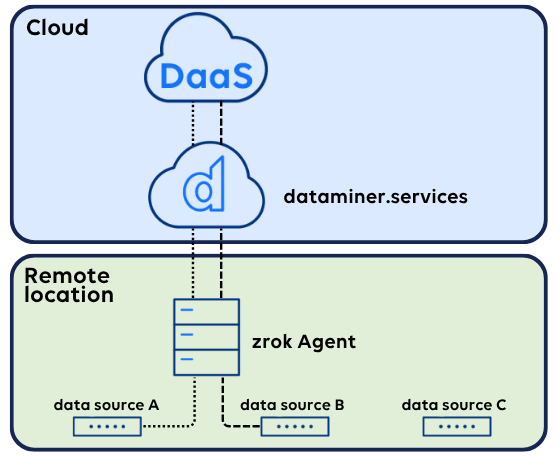
Tunneling overview