Provisioning endpoints and virtual signal groups for a Generic Matrix element using CSV import
In this tutorial, you will learn how to use the CSV import functionality in the Virtual Signal Groups app to provision endpoints and virtual signal groups (VSGs) for the Generic Matrix connector. These endpoints and VSGs will be used to visualize and manage the connections in the MediaOps Live solution.
There are three ways to create endpoints and VSGs:
- Using the CSV import functionality in the Virtual Signal Groups app, as explained in the current tutorial.
- Manually, using the Virtual Signal Groups low-code app.
- Through an automation script, using the MediaOps Live API.
Expected duration: 15 minutes
Note
The content and screenshots of this tutorial were created using DataMiner 10.6.4 and MediaOps Live 1.0.0.
Prerequisites
The DataMiner System you use for this tutorial must meet the following prerequisites:
- Range 1.0.1.x of the Generic Matrix connector is installed, and an element has been created using this connector.
- MediaOps Live is installed.
Overview
- Step 1: Create level and transport type
- Step 2: Export existing endpoints
- Step 3: Export existing virtual signal groups
- Step 4: Import new endpoints
- Step 5: Import new virtual signal groups
Step 1: Create level and transport type
First, you need to create a level and transport type in MediaOps Live. In this tutorial, the Video level and SDI transport type will be used. If these already exist in your system, you can skip this step.
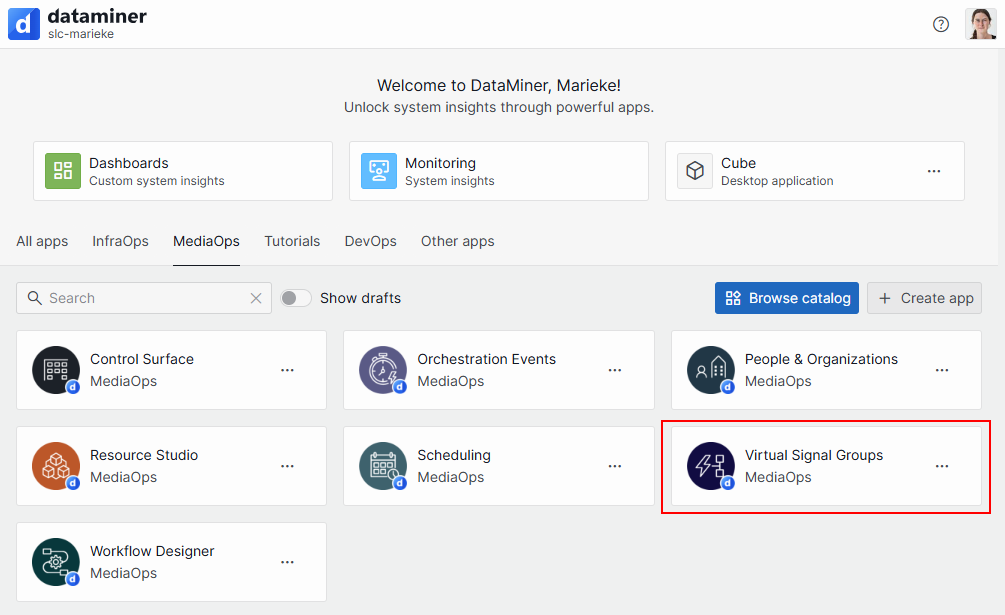
Open the Virtual Signal Groups app.
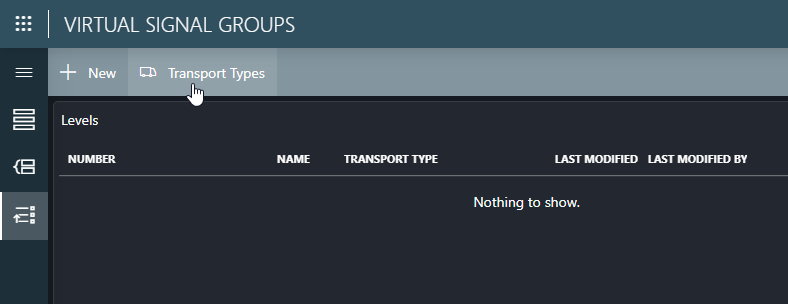
Go to the Levels page, and click the Transport Types button in the header bar.
If the
SDItransport type does not exist yet, create it by clicking the New button and specifying this transport type name.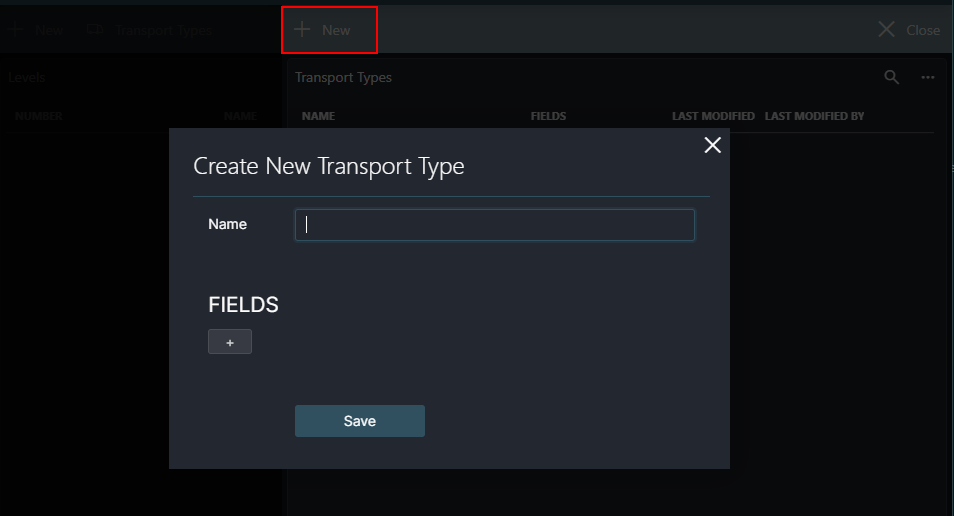
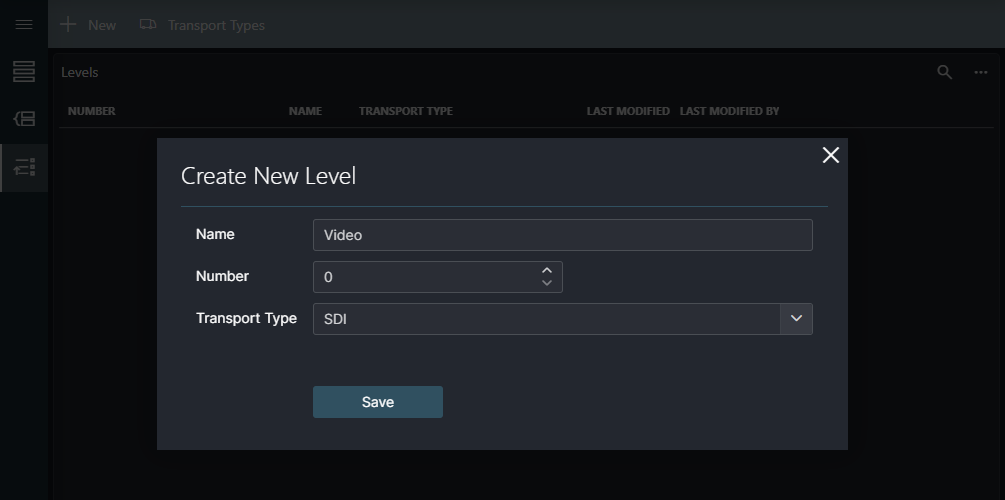
Back on the Levels page, if the
Videolevel does not exist yet, create it by clicking the New button and specifying the following information:- Name:
Video - Number:
0(or the next available number) - Transport Type:
SDI
- Name:
Step 2: Export existing endpoints
In this step, you will export the existing endpoints to a CSV file, so you can use this as a template to create new endpoints or use it to update existing endpoints. The exported file will contain all the necessary columns and formatting required for the import.
In the Virtual Signal Groups app, go to the Endpoints page.
Click the Export button in the header bar.
In the pop-up window, provide a name for the export file, e.g.,
endpoints_export.csv.Click Export to download the CSV file to your computer.
The exported CSV file will contain the following columns:
- ID
- Name
- Role
- Element
- Identifier
- Control Element
- Control Identifier
- Transport Type
- Other specific columns related to the transport type
Step 3: Export existing virtual signal groups
Similar to the previous step, you will now export the existing virtual signal groups to a CSV file.
In the Virtual Signal Groups app, go to the Virtual Signal Groups page.
Click the Export button in the header bar.
In the pop-up window, provide a name for the export file, e.g.,
virtual_signal_groups_export.csv.Click Export to download the CSV file to your computer.
The exported CSV file will contain the following columns:
- ID
- Name
- Description
- Role
- Endpoints on different levels (one column per level)
Step 4: Import new endpoints
In this step, you will use the CSV file format to create new endpoints for the Generic Matrix element. The CSV import allows you to quickly add multiple endpoints at once, rather than creating them manually.
Open the
endpoints_export.csvfile that you exported in step 2.Delete all rows except the header row.
The file should now look like this:
ID;Name;Role;Element;Identifier;Control Element;Control Identifier;Transport Type;...To create a new source endpoint for input 1 of the Generic Matrix element, add the following line to the CSV file:
;Matrix Input 1;Source;Matrix;1;;;SDI;;;The ID column is intentionally left empty, as it will be automatically assigned during the import. To update an existing endpoint, you would need to provide the ID of that endpoint.
The above line will create a new source endpoint named
Matrix Input 1, linked to row key1of the inputs table of elementMatrix, usingSDIas transport type.Note
Endpoint and virtual signal group names are unique across your entire MediaOps Live system. If you use a name that already exists, importing the file will update the existing endpoint or virtual signal group instead of creating a new one. Deleting endpoints or virtual signal groups is currently not supported through the CSV import.
Similarly, to create a new destination endpoint for output 1, add the following line to the CSV file.
;Matrix Output 1;Destination;Matrix;1;;;SDI;;;This time
Destinationis used as the role; and the endpoint is linked to row key1of the outputs table of the element.Add more lines, similar to the lines above, to create more endpoints as needed.
Save the CSV file after making your changes.
The file should now look like this:
ID;Name;Role;Element;Identifier;Control Element;Control Identifier;Transport Type;TSoIP-Source IP;TSoIP-Multicast IP;TSoIP-Port
;Matrix Input 1;Source;Matrix;1;;;SDI;;;
;Matrix Output 1;Destination;Matrix;1;;;SDI;;;
Import the file again:
Go back to the Endpoints page in the Virtual Signal Groups app.
Click the Import button in the header bar.
In the pop-up window, upload the modified CSV file by clicking Upload button and selecting the file from your computer.
Click Import to start the import process.
The new endpoints should now appear in the list.
Step 5: Import new virtual signal groups
After adding the endpoints, the next step is to define and import the virtual signal groups (VSGs). A VSG groups one or more endpoints together across different levels (e.g., video, audio, data) and is typically used to represent a logical signal flow in your system.
In this step, you will create a VSG for each endpoint created in the previous step. The endpoints will be assigned on the Video level, but you can adjust this based on your needs. Make sure to use the same level for sources and destinations.
Open the
virtual_signal_groups_export.csvfile that you exported in step 3.Delete all rows except the header row. The file should now look like this:
ID;Name;Description;Role;Endpoint (Video);Endpoint (Audio1);Endpoint (Audio2);Endpoint (Data)To create a VSG for the source endpoint
Matrix Input 1that you created in the previous step, add the following line to the CSV file:;Matrix Input 1;;Source;Matrix Input 1;;;The ID is again left empty to make sure a new VSG is created. To update an existing VSG, you would need to provide the ID of that VSG.
Make sure the
Rolecolumn hasSourceas value.The endpoint is assigned on the
Videolevel by placing the endpoint name in the corresponding column. Levels that are not used can be left empty.In a similar way, to create a VSG for the destination endpoint
Matrix Output 1, add the following line to the CSV file:;Matrix Output 1;;Destination;Matrix Output 1;;;This time,
Destinationis used as the role. The endpoint is again assigned on theVideolevel.Add more lines, similar to the lines above, to create more VSGs as needed.
Save the CSV file after making the changes.
The file should now look like this:
ID;Name;Description;Role;Endpoint (Video);Endpoint (Audio1);Endpoint (Audio2);Endpoint (Data)
;Matrix Input 1;;Source;Matrix Input 1;;;
;Matrix Output 1;;Destination;Matrix Output 1;;;
The file is now ready to be imported. To do so:
Go back to the Endpoints page in the Virtual Signal Groups app.
Click the Import button in the header bar.
In the pop-up window, upload the modified CSV file by clicking Upload button and selecting the file from your computer.
Click Import to start the import process.
The new virtual signal groups should appear in the list.
Up next
When you have finished this tutorial, you can continue with creating a connection handler script. This script will use the endpoints and virtual signal groups that you have created in this tutorial to visualize and manage connections.